Insights
A Warehouse Shift Handoff That Doesn't Depend on Memory
iCorp Systems ·
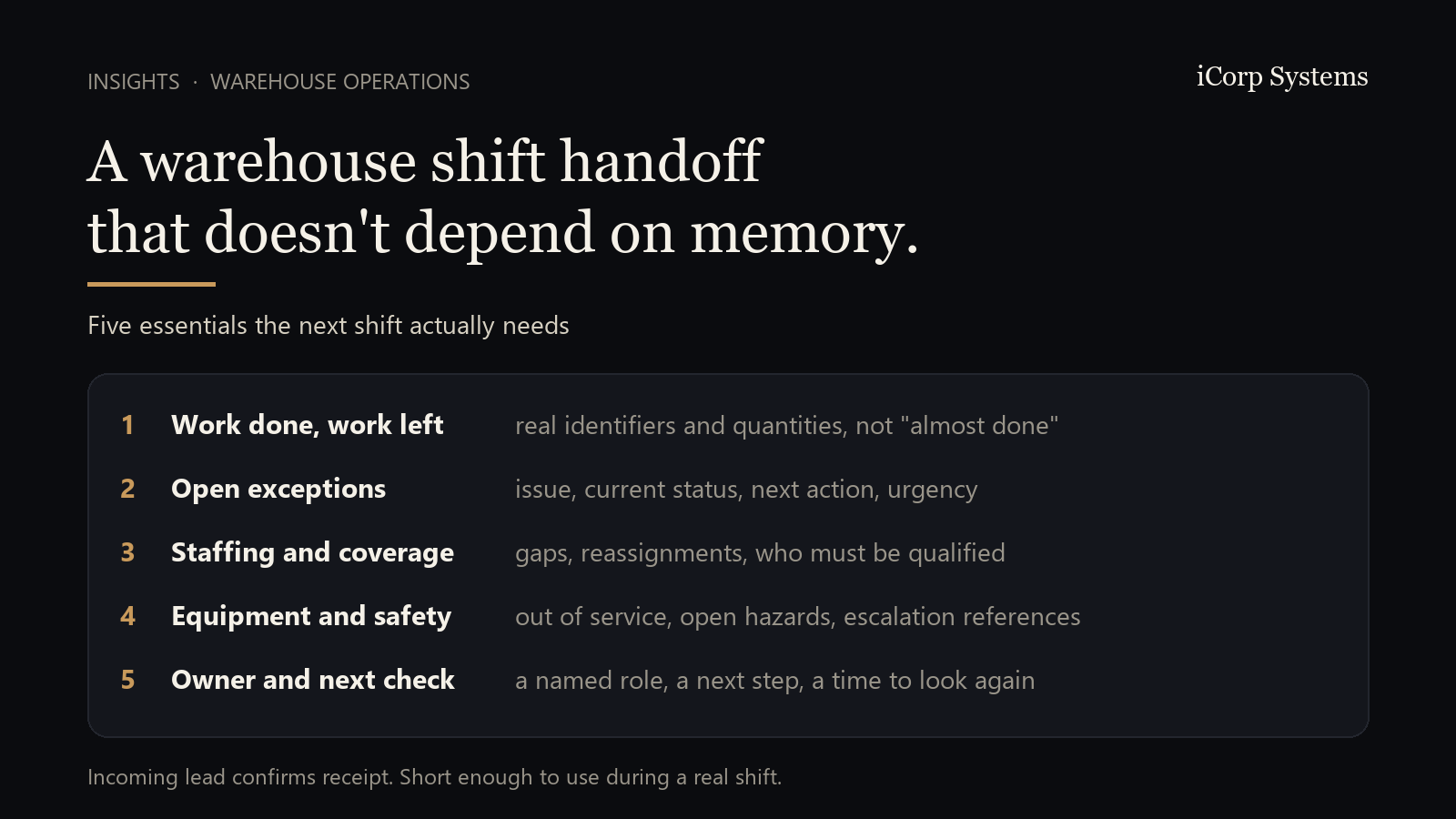
Five operational essentials for a warehouse shift handoff you can use today — volume, exceptions, staffing, equipment and ownership — plus a seven-field handoff template.
A warehouse shift handoff is not a recap of everything that happened. It is a short transfer of responsibility for work that is still open.
When handoffs are casual, the next supervisor spends the first part of the shift rediscovering exceptions, asking who owns them, or discovering too late that a truck, system or piece of equipment is still blocked. The answer does not have to be another complicated software rollout. Start with a repeatable, written handoff.
Five operational essentials the next shift needs.
1. Work completed and work left. Record what was completed, what remains, and which loads, routes or orders need attention. Use actual identifiers and quantities when you have them. Do not write "almost done" in place of a number.
2. Exceptions. List short shipments, damaged goods, late arrivals, missing documents, blocked orders and other unresolved problems. Each exception needs a clear current status and the next action.
3. Staffing and coverage. Note absences, changes to assignments, training gaps, and work that requires a specifically qualified person. Avoid putting private employee details in a broadly shared shift document.
4. Safety and equipment. Record equipment marked out of service, unresolved hazards, and open maintenance requests. Never replace an actual safety escalation or lockout procedure with a note in the handoff.
5. Ownership and deadline. Every open item needs a named role or owner, a next step and a time to check again. "Someone is handling it" is not an assignment.
Copy-and-use shift handoff template: seven fields, one line each — the five essentials above plus a shift header and an acknowledgement.
Shift and date: outgoing shift, incoming shift and handoff time.
Volume: completed, remaining and at-risk work, with real identifiers.
Open exceptions: issue, current status, next action, urgency.
Equipment and safety: out-of-service assets, open hazards, escalation references.
Coverage: roles needing attention and assignment changes.
Owners: a responsible owner and next-check time for each open issue.
Acknowledgement: the incoming lead confirms receipt and calls out unclear items.
The rule that makes the checklist work: the outgoing supervisor prepares the handoff before leaving. The incoming supervisor reads it and confirms which issues are being taken over. If something is unclear, resolve it during the overlap rather than after the first missed pickup.
Keep the record short enough to use during an actual shift. A one-page system that supervisors follow is more valuable than a five-page report that gets skipped.
Where automation helps. Once the basic handoff is reliable, software can reduce manual copying: pull open exceptions from the system of record, highlight overdue items, and route an acknowledgement to the right person. The goal is not to add another screen. It is to make unresolved work visible early enough to act.
If you'd like to identify where your operation depends too heavily on texts, spreadsheets and memory, start with iCorp's free Business MRI.